Park and Ride Nuremberg: 645 City Spaces, 300 Across the VGN
Nuremberg itself gets by with six park-and-ride sites and 645 spaces – yet behind that sits the VGN, a transport association with over 300 sites and its own in-app route planning, whose largest facilities sit not in Nuremberg but in Bamberg, Ansbach and Neumarkt.

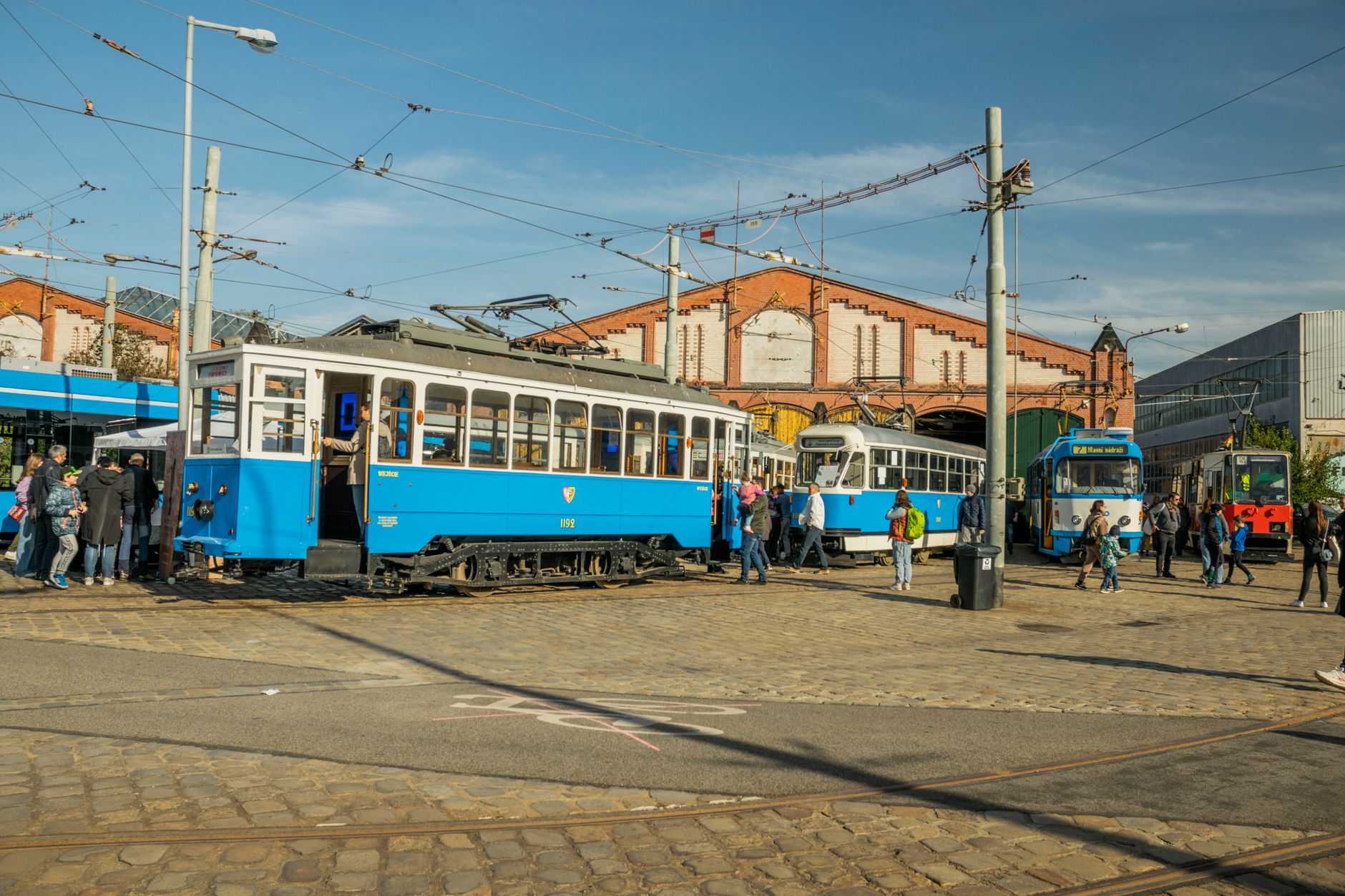
By population, Nuremberg is one of Germany’s more compact big cities – the transport association that ties it to its hinterland, by contrast, is one of the largest in the country. Search for park and ride in Nuremberg and you quickly run into a mix-up that obscures the real question: within the city limits themselves there are only a handful of sites, fewer than 650 spaces in total – a modest figure next to a city such as Berlin. The true scale of the offer only becomes visible once you look past the city boundary, because the Verkehrsverbund Großraum Nürnberg (VGN), the regional transport association, lists more than 300 park-and-ride sites in its own directory across the whole network area – from Bamberg in the north to Neumarkt in the Upper Palatinate in the south. That gap between a small city and a large association shapes almost every practical question that follows: where the big sites actually are, how you find them, and when the detour to the edge of town is worth making at all.
A Transport Association Bigger Than the City It Serves
Understanding park and ride in Nuremberg starts with the organisation behind it. The VGN covers roughly 22,000 square kilometres and around 3.6 million residents, an area that reaches well beyond Middle Franconia into parts of Upper and Lower Franconia, the Upper Palatinate, Swabia, and even Upper and Lower Bavaria. By area, that makes it one of Germany’s largest transport associations. The network is run by a web of operators – DB Regio, VAG in Nuremberg itself, infra fürth, the Erlangen municipal utility ESTW, Omnibusverkehr Franken, and dozens of further municipal and private bus companies – running around 1,100 lines between them.
For the tariff system, that scale produces a different geometry from Berlin or Frankfurt. The VBB grades its fares in rings around a single city; the RMV ties public transport tightly to one conurbation. The VGN, instead, counts outward from three independent cities at once – Nuremberg, Fürth and Erlangen each form their own starting point, with ten tariff tiers for single tickets and nineteen for season tickets (as of 2026). For park and ride, that means there is no single city edge where the switch to rail logically happens, but a whole territory in which the sensible interchange point depends on your particular commute.
Over 300 Sites, an App Instead of a Central Office
The VGN’s own directory lists well over 300 park-and-ride locations across the entire network area, ranging from tiny plots with three to eight spaces up to large facilities with several hundred. A collection that size can no longer be navigated as a simple list, and the VGN’s answer is a digital one: its app lets you switch on “P+R route guidance,” which combines the journey to your destination directly with a suitable site. You can filter specifically for free spaces or set a preferred station, and for some locations the map view even shows an occupancy forecast. The same function is available in the web-based journey planner, under its own park-and-ride tab.
That marks Nuremberg out clearly from the two other systems compared here. In Berlin there is practically no central source of information at all – finding a site relies on local knowledge, because the land belongs to different owners and is documented nowhere in one place. In Frankfurt, meanwhile, digital booking through the APCOA FLOW app is so far limited to a single pilot site. The VGN takes the opposite approach: physical responsibility for each individual plot stays scattered across dozens of municipalities and operators, but a single digital layer sits above all of it, covering the whole network area – unusual for a system of this size.
Why the Biggest Sites Aren’t in Nuremberg
Sort the VGN’s sites by capacity and the largest turn out not to be in Nuremberg at all, but in the county towns at the edges of the network area: Bamberg Heinrichdamm with 784 spaces, Erlangen central station with 677 in total, Neumarkt in der Oberpfalz with 628, Ansbach with 589, and Schwabach with 459 in total. Every one of these outstrips the biggest site inside Nuremberg itself.
The reason lies in the settlement geography of the region. In a mono-centric system such as Berlin or Frankfurt, the switch from car to rail happens exactly where the city ends – the city edge is the only ring that matters. The VGN area has a second, more distant ring as well: commuters from the rural hinterland around Bamberg, Ansbach or Neumarkt do not wait until the Nuremberg city limit to change mode; they switch already at the edge of their own county town, from where a 30- to 60-minute S-Bahn or regional train ride takes them into Nuremberg, Fürth or Erlangen. Nuremberg’s own sites, by contrast, serve mainly people who already live within the city or its immediate suburbs.
The Six Sites Within the City Limits
Within Nuremberg itself, the VGN directory names six sites, totalling 645 spaces (as of 2026):
| Site | Spaces | Line | Notable feature |
|---|---|---|---|
| Nürnberg-Herrnhütte | 470 | U2 | the city’s largest, with 24 women-only and 6 disabled spaces |
| Nürnberg Am Wegfeld | 84 | Tram 4/10 | explicitly free of charge, 4 EV charging points |
| Nürnberg Laufamholz | 38 | S1 | eastern city edge |
| Nürnberg Mögeldorf | 22 | S1 | close to the centre, small plot |
| Nürnberg Schweinau | 18 | U2 | also an S-Bahn stop towards Ansbach |
| Nürnberg Ostbahnhof | 13 | Regional rail, tram 8 | the city’s smallest site |
What stands out is how differently these six sites connect to the network. Herrnhütte and Schweinau both sit on the U2, which runs from Röthenbach in the south-west, through the city centre, to the airport in the north-east. Am Wegfeld is the northern terminus of two tram lines at once and also a bus hub towards Fürth, Knoblauchsland, the airport and Erlangen. Laufamholz and Mögeldorf hang off the S1 in the city’s east, while Ostbahnhof links regional trains into the Pegnitz valley with tram line 8. There is no single rule of thumb that covers all six – anyone looking for a site is better off thinking from their own home location outward than assuming a shared pattern.
Herrnhütte: From Tram Terminus to the City’s Largest Site
The largest site within the city limits, by some distance, deserves a closer look, not least because its history is typical of how Nuremberg’s public transport network has been rebuilt over time. Herrnhütte, roughly three kilometres north-east of the centre, was originally the terminus of a tram line; that line was later replaced by the U-Bahn. Today’s station sits on the U2 between Nordostbahnhof and Ziegelstein, giving the site a direct, no-change connection to both the city centre and Nuremberg Airport.
Right next to it sits Nürnberg Nordost, a separate station on the Gräfenbergbahn, a regional line running into the north-eastern hinterland – so anyone arriving from that direction has two independent rail connections to choose from at the same spot, not just one. With 470 spaces, including 24 dedicated women-only bays and 6 disabled spaces, Herrnhütte is also the only Nuremberg site whose scale can genuinely compete with the large facilities in Bamberg or Ansbach. The women-only bays follow a principle common in German multi-storey car parks: well-overlooked, usually well-lit spaces close to the entrances and exits.
Free of Charge – But Worth Checking First
For Nürnberg Am Wegfeld, the position is unambiguous: the VGN directory lists the site explicitly as free of charge, alongside four EV charging points. That puts it on the same footing as the Rheinbahn sites in Düsseldorf – parking with no fee, no barrier, no ticket of its own – and sets it clearly apart from the new, RMV-ticket-linked model in Frankfurt, where a €20 monthly pass is now a precondition.
Whether that principle holds across all 300-plus sites in the network area is another matter. Tellingly, the VGN app itself offers a filter for “free parking spaces only” – a filter that would serve no purpose if the same rule applied everywhere. The VGN does not publish a single, network-wide price list; the fee question is evidently settled site by site, depending on who owns the land and how it is managed. In practice, that means a quick check of the app or the relevant station page before relying on an unfamiliar site is worth a minute of your time, against the surprise of an unexpected charge at the exit (as of 2026).
The Sums Against the Old Town
To put the cost question in perspective, it is worth weighing it against the alternative that park and ride is meant to replace: driving all the way into Nuremberg’s old town. There, the city’s guidance system co-ordinates roughly 5,300 spaces across public multi-storey and underground car parks, with signage that shows each building’s free spaces in real time – a well-thought-out system that noticeably eases the search for a space once you are already in the old town. The trade-off is price: multi-storey car parks in German city centres of this size typically run to several euros an hour, and across a full working day or a long shopping trip that quickly adds up to a double-digit sum (as of 2026, without fixed individual rates, which vary by operator).
Anyone using one of Nuremberg’s six park-and-ride sites instead, while already holding a Deutschlandticket – €63 a month since January 2026 – or a VGN season ticket, often pays nothing extra at all for the space itself. The difference from an old-town underground car park is therefore not one of degree but of kind: no hourly rate ticking up with every extra errand, but a ticket you would need regardless.
Where the Detour to the Edge of Town Pays Off
Whether park and ride is worth it in Nuremberg depends, more than elsewhere, on which layer of the network you are operating in. Live in the city itself or a nearby suburb, and already pass Herrnhütte, Am Wegfeld or one of the four smaller sites, and the calculation is straightforward: a free or at least inexpensive space, a U-Bahn or S-Bahn connection of a few minutes, and an old town you never have to drive into. Commute instead from further out – from the Bamberg, Ansbach or Neumarkt districts – and your real park-and-ride decision usually sits a step earlier, at one of the large sites in your own county town, rather than at the Nuremberg city limit.
Another city with a much larger, basin-geography-driven P+R network is Stuttgart, covered under park and ride in Stuttgart.
What holds true in both cases is worth repeating: check the VGN app before the first trip to an unfamiliar site, rather than assume. Unlike Berlin, where that kind of check is next to impossible for lack of any central source, the VGN actually supplies the tools to do it, with occupancy forecasts and a cost filter built in – they simply have to be used. Nuremberg’s real distinguishing feature, then, is not any single large facility but the quiet digitisation of a network that looks unwieldy at first glance and, on closer inspection, no longer is. Further systems are compared in the nationwide overview under Park & Ride.
Keep reading
Park & Ride
Park and Ride Stuttgart: 215 Sites Between the Basin and the Fildern
Park and ride in Stuttgart 2026: 215 sites with roughly 17,370 spaces across the VVS network, a six-month subscription instead of a day ticket – and why the city's basin shapes where it all sits.
Dr. Eva Sommer11 August 2026
Park & Ride
Park and Ride in Cologne: Free Parking, but Only With a Ticket
Park and ride in Cologne in 2026: 24 KVB sites, around 5,400 spaces, parking free of charge — with a valid ticket and for no more than 24 hours. Fares, Weiden West, Porz and the low-emission zone.
Dr. Eva Sommer17 September 2026
Park & Ride
Park and Ride in Leipzig: Free, No Ticket Required, No Barrier
Park and ride in Leipzig in 2026: seven city sites with around 3,130 spaces, all free of charge and open around the clock. Fares, the Messe, Stötteritz and the low-emission zone.
Dr. Eva Sommer17 September 2026
Park & Ride
Park and Ride Munich: 38 City Sites, Three Price Levels, Day Rates from €1
Park and ride in Munich in 2026: the 38 sites of the city-owned P+R Park & Ride GmbH with more than 14,000 spaces, day rates of €1.00 to €2.00, which U-Bahn and S-Bahn lines they serve, the standard rate for non-travellers, and how it compares with parking in the centre.
Dr. Eva Sommer25 September 2026
Park & Ride
Park and Ride in Berlin: A Patchwork, Not a System
Park and ride in Berlin, 2026: dozens of sites at U-Bahn, S-Bahn and regional stations, mostly free, with no central authority — and a fare boundary that runs through the middle of some stations.
Dr. Eva Sommer6 July 2026