Park and Ride in Berlin: A Patchwork, Not a System
Unlike Hamburg or Munich, Berlin has no unified park-and-ride scheme with its own tariff — instead a scatter of sites under different operators, mostly free of charge, rarely policed, and tightly bound up with a fare boundary that at one station runs straight through the platform.

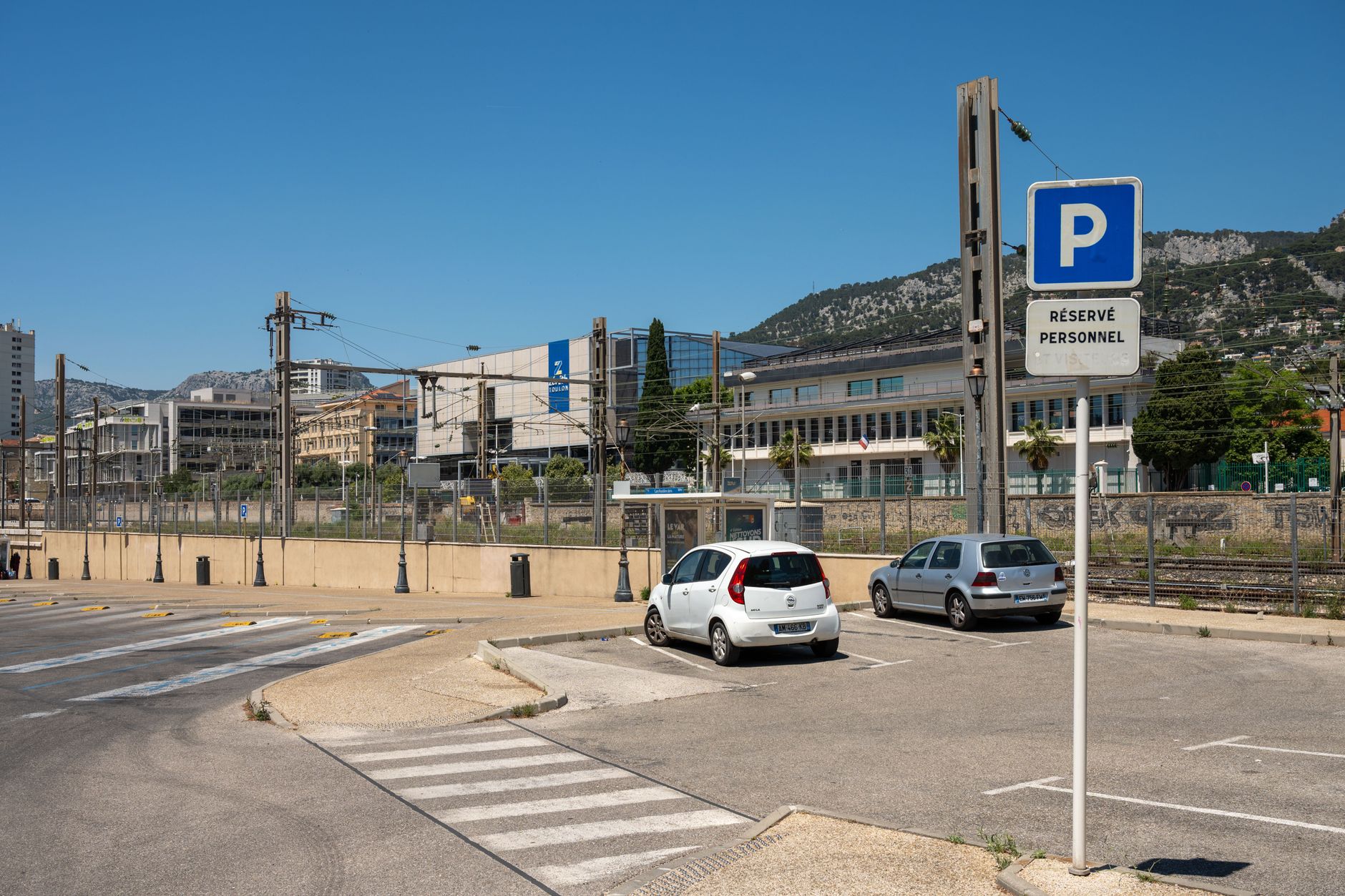
Search for park and ride in Hamburg or Munich and you find a responsible authority, a price list and an app. Search for it in Berlin and you find a map with a scatter of dots — and for most of them, no single authoritative answer as to who runs the site, how many spaces it has, or whether it is even worth using at a given time of day. That is not an oversight. It is the outcome of a system that was never designed as one: each site grew up wherever a station, a turning circle or a patch of spare land at the edge of the city happened to coincide.
A Different Subject from the Inner-City Zones
Before turning to the sites themselves, a distinction worth making, because it gets muddled in Berlin more often than in other cities. Park and ride has almost nothing to do with managed inner-city parking, even though both fall under “parking in Berlin” and both are the responsibility of the same Senate department.
Managed parking refers to the borough-run zones with pay-and-display and resident permits that apply in Mitte, Kreuzberg or Prenzlauer Berg — a system of machines, mobile payment and a resident permit costing €20.40, which I have covered in detail under Berlin Parking Zones. Park and ride, by contrast, happens at the edges, where U-Bahn lines terminate, S-Bahn rings open out, and regional trains branch off into Brandenburg. It is not about parking as a scarce resource in itself, but about switching from car to rail before the expensive, congested part of the city even begins.
Confuse the two and you tend to reach the wrong decision either way: an inner-city zone helps nobody commuting in from Falkensee or Königs Wusterhausen, and a site on the edge of town is no use to someone who lives in Kreuzberg and wants to park there.
The ABC Fare Zones and Their Friction at the Edge
To understand where park and ride works in Berlin and where it does not, it helps to glance at the fare system run by the Verkehrsverbund Berlin-Brandenburg (VBB), because P+R lives almost entirely along its outer edge.
The VBB divides its territory into three zones. Fare zone A covers the inner city; the defining line is the Ringbahn, whose stations belong to zone A exclusively. Fare zone B covers the rest of Berlin’s urban area out to the city boundary. Fare zone C extends roughly 15 kilometres beyond that into Brandenburg, and rather than forming a simple ring, it is cut as a series of half-circles around the larger outlying towns such as Potsdam, Frankfurt (Oder) and Brandenburg an der Havel. There are no single-zone tickets: you always buy a combination — AB for travel within the city, ABC for travel out into the surrounding region. The BC combination, which used to cover the outer zones without the city centre, has not been sold since 2025 (as of 2026).
It is exactly along this boundary that most of Berlin’s P+R sites sit, and exactly there that administrative lines and everyday journeys can collide in ways that are hard to predict. A particularly clear case is U-Bahnhof Hönow, the eastern terminus of line U5: the station itself sits in fare zone B, but the bus stops directly outside it already lie in zone C. Anyone changing from the U-Bahn to the bus therefore needs a more expensive ticket that includes zone C — a situation that has reportedly drawn a good many complaints, not least because bus route 395, running between Mahlsdorf and Hellersdorf, passes through several Hönow stops and so requires a C-ticket even though the journey itself barely leaves the city.
For you as a commuter, the practical upshot is this: what your onward journey costs depends not only on where you park but on which side of an often invisible line your space and your stop happen to fall. Checking the fare zone before your first trip saves an unwelcome surprise at the machine or in the app.
Where the Sites Actually Are
Because there is no central, continuously maintained overview, thinking in terms of compass direction is more useful than any bare list of names. Berlin’s P+R landscape follows, in essence, the termini of the U-Bahn lines and the points where the S-Bahn and regional trains cross into the Brandenburg hinterland.
To the south and south-east, U-Bahn lines U7 and U6 terminate at Rudow and Alt-Mariendorf respectively, both close to the city boundary and traditionally offering space for people switching over from the southern hinterland. Further east follow the S-Bahn stations towards Königs Wusterhausen — Grünau, Schmöckwitz, Zeuthen — together with the regional line via Erkner, where commuters from eastern Brandenburg join the Berlin network. To the east of the city itself sits Hönow, with the fare quirk described above; to the north-east follow Ahrensfelde and Wartenberg, along with the S-Bahn stations of Mahlsdorf and Kaulsdorf on the line towards Strausberg.
To the north, it is chiefly the S-Bahn stations of Buch, Karow and Blankenfelde that mark the transition to the Brandenburg hinterland — the last of these with a notable piece of physical evidence: the old station building on the western side of the tracks was demolished in 2009 to make way for a multi-storey car park, a visible sign that capacity was actually invested in there rather than a patch of ground merely being set aside. Further north-west lie Birkenwerder and Hennigsdorf, on the lines towards Oranienburg and Velten respectively.
To the west, U-Bahn line U2 terminates at Ruhleben, while the S-Bahn runs on via Spandau and Staaken towards Falkensee and the western Havelland. And then there is the exception that proves the rule: S-Bahnhof Plänterwald, sitting well inside the city on the Ringbahn, with a facility that is tiny by Berlin standards — eight generally available spaces — a leftover, it seems, from a time when P+R was also imagined within the inner city, and today more a curiosity than a practical offer.
Free, But Not Coordinated
The good news first: at the great majority of Berlin’s P+R sites, parking itself costs nothing (as of 2026). There is no barrier, no machine, and no ticket that has to be bought specifically for the space — unlike Hamburg, where use is tied to a day or annual card.
The less good news follows immediately. This lack of charge is not a deliberately designed offer so much as a by-product of nobody clearly being in charge. The land belongs to different owners — DB Station&Service or S-Bahn Berlin at stations owned by Deutsche Bahn, the BVG at some U-Bahn termini, the boroughs or private landowners elsewhere. There is no shared signage, no common opening pattern, and certainly no app that pulls all the sites together in one place. In practice, anyone wanting to use a site relies on local knowledge or on whatever becomes apparent on arrival.
For you as a user, that amounts to a trade. You are spared the calculation Hamburg commuters have to make — whether an annual card pays for itself after fifty trips — but you pay for that with uncertainty. Whether a given site still exists, how large it is, and whether it is surfaced or just gravel is, in a good many cases, something you only find out once you get there.
Full Car Parks by Early Morning
The combination of no charge and no coordination produces a pattern that experienced commuters know well and that occasional users are regularly caught out by: the larger sites are often full by seven or eight in the morning on working days.
This is not really a Berlin peculiarity so much as the logical result of a system with no price signal. Hamburg’s two-euro charge was introduced partly to curb exactly this effect — the experience there shows that even a small but visible sum is enough to keep long-stay parkers and second cars off the sites. Berlin has no such lever, and availability is correspondingly harder to predict.
A comprehensive, reliable online display of free spaces, of the kind now common elsewhere, does not exist consistently across Berlin’s P+R sites (as of 2026). The practical consequence: if you depend on a particular site, build in a time buffer as a matter of course, or work out in advance which second station could serve as a fallback, rather than relying on a single location.
The Reckoning Against the City Centre
To keep the free-of-charge sites at the edge of town in perspective, it is worth comparing them with the alternative P+R is meant to replace: driving all the way into the managed inner-city zones.
There, parking charges run between one and three euros an hour depending on borough and location, as I have set out in detail under Berlin Parking Zones. Over an eight-hour working day in an expensive location, that easily adds up to €20–24 — every day, not once. A resident permit does not help here, since it applies only to your own zone and in any case requires a Berlin registration address plus a processing time of up to twenty weeks. For anyone commuting in from Falkensee, Erkner or Königs Wusterhausen, the permit was never an option to begin with.
Against that, all P+R asks of you is the fare for the onward journey by bus, train or U-Bahn — a ticket you would need anyway if you were not driving the whole way. The difference is therefore substantial, particularly on a fixed, regular route: commute five days a week and, over a month, you save a sum that comfortably outweighs the minor inconveniences of Berlin’s P+R landscape — the missing occupancy display, the uncertain availability.
Bicycle Instead of Car to the Station
For the last few kilometres to the station, a bicycle is often the better answer, and Berlin has invested in cycle parking at a handful of larger hubs in recent years — from simple rows of stands to lockable boxes and, at a few busy stations, covered collective facilities. That said, this is not the comprehensive, consistently equipped infrastructure found in Düsseldorf or Hamburg; quality varies considerably from one station to the next.
Where a good facility exists, it is generally the more economical and more dependable choice against the car: it occupies none of the scarce car spaces, it is still usable at eight in the morning when the car park is already full, and it removes the search for a space entirely. If you have two or three kilometres to cover to the nearest station, it is worth weighing this option before defaulting to the car — precisely because the car offers no guarantee of a space at the Berlin city edge.
When the Detour via the City’s Edge Pays Off
Whether park and ride is worth it in Berlin depends, more than in other cities, on how well you know the particular site you intend to use — because there is no system standing behind you to absorb that uncertainty.
Clearly in its favour is the position of many commuters from Brandenburg: if you already need a ticket covering zone C because your home lies beyond the Berlin city boundary, the parking space itself costs nothing extra — an advantage neither Hamburg nor Munich offers in this form, where even the discounted annual card is tied to an existing subscription. Equally clearly in its favour is any journey that would otherwise end in a managed inner-city zone: a difference of several euros an hour makes the detour via an edge-of-city station worthwhile almost every time, even if the site there should turn out to be full and a second attempt is needed.
What tells against it is chiefly the lack of reliability itself. Anyone who depends on arriving on time and does not know the specific site from experience takes on a risk that does not exist in the same form in Düsseldorf, where more than a dozen Rheinbahn sites are likewise free of charge but considerably better documented, as described under park and ride in Düsseldorf. And anyone driving to the city edge only occasionally does well to check with the relevant operator beforehand rather than relying on a single source. How differently German cities handle the concept overall, from the tiered southern German tariff to the northern German annual card, is set out in the city comparison under park and ride in Germany.
A city with a considerably tighter park-and-ride supply, but a new fare model since autumn 2025, is Frankfurt, covered under park and ride in Frankfurt. If the destination is the airport rather than the city, that logic falls away entirely: BER sits in the same zone C, but its car parks answer to a calculation of their own, made up of walking distances and weekly caps, set out under parking at BER Airport.
Berlin’s P+R landscape will probably keep changing over the coming years, not least because the VBB is modernising its fare system in line with the national eTicketing standard, and individual boroughs are considering better documentation of the sites that already exist. Until then, what holds today is likely to keep holding: the sites are mostly free, rarely signposted with any consistency, and most predictable for those who use them regularly and know their particular quirks. All figures reflect the position in 2026; responsibilities and capacities change at individual sites without being tracked centrally. More systems in city-by-city comparison are covered under Park & Ride.
Keep reading
Park & Ride
Park and Ride Nuremberg: 645 City Spaces, 300 Across the VGN
Park and ride in Nuremberg 2026: six city sites with 645 spaces, 300+ across the VGN network – mostly free, with app routing rather than a ticket machine.
Dr. Eva Sommer5 August 2026
Park & Ride
Park and Ride Munich: 38 City Sites, Three Price Levels, Day Rates from €1
Park and ride in Munich in 2026: the 38 sites of the city-owned P+R Park & Ride GmbH with more than 14,000 spaces, day rates of €1.00 to €2.00, which U-Bahn and S-Bahn lines they serve, the standard rate for non-travellers, and how it compares with parking in the centre.
Dr. Eva Sommer25 September 2026
Park & Ride
Park and Ride in Cologne: Free Parking, but Only With a Ticket
Park and ride in Cologne in 2026: 24 KVB sites, around 5,400 spaces, parking free of charge — with a valid ticket and for no more than 24 hours. Fares, Weiden West, Porz and the low-emission zone.
Dr. Eva Sommer17 September 2026
Park & Ride
Park and Ride in Leipzig: Free, No Ticket Required, No Barrier
Park and ride in Leipzig in 2026: seven city sites with around 3,130 spaces, all free of charge and open around the clock. Fares, the Messe, Stötteritz and the low-emission zone.
Dr. Eva Sommer17 September 2026
Park & Ride
Park and Ride Düsseldorf: Free at Rheinbahn Stops, Priced at the Airport
Park and ride in Düsseldorf in 2026: more than a dozen free Rheinbahn car parks with over 1,400 spaces — and the one paid CombiTicket at the airport that proves the rule.
Dr. Eva Sommer3 July 2026