Park and Ride in Cologne: Free Parking, but Only With a Ticket
In Cologne the space costs nothing; the right to use it costs the fare. Miss that distinction and you owe a €30 contractual penalty — overrun the 24 hours and you owe it again, for every further day begun.

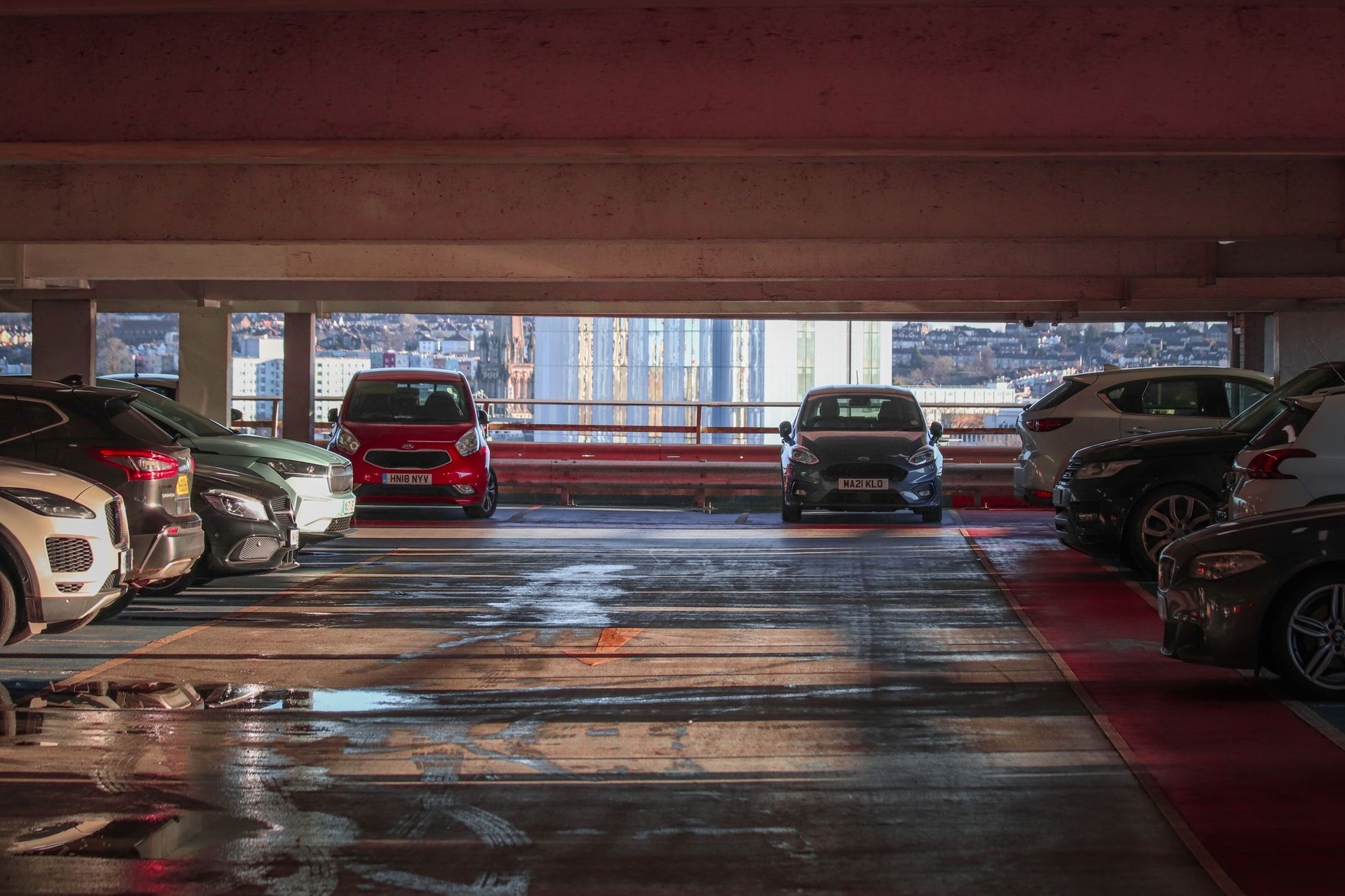
Cologne answers the park-and-ride question differently from its neighbours, and the difference fits into a single sentence: the space costs nothing, the entitlement to use it costs the fare. In Hamburg you buy a day ticket for the parking itself at a machine. In Düsseldorf you leave the car and walk away, and nobody wants anything from you. In Cologne you also park without a barrier and without a ticket machine — but the moment you drive in you enter a contract, and it hangs on two written conditions.
Kölner Verkehrs-Betriebe (KVB) run 24 such sites, from a 23-space strip at the kerb to a surface car park holding 1,316 vehicles. Added together, the capacities KVB publishes for each site come to roughly 5,400 spaces (as of 2026). All are open around the clock; a few are staffed, most are not.
Free in Cologne means: with a ticket, and for no more than 24 hours
KVB puts the rule plainly: at its park-and-ride sites you may park free of charge for up to 24 hours provided you hold a valid public transport ticket — a Deutschlandticket, a season ticket, a single fare and so on — and you arrive at or depart from the site immediately by the services that call there.
The terms of use posted at every site turn that into a contract. Clause 1: driving in creates a contractual relationship between you and KVB AG. Clause 3: only vehicle occupants who leave or arrive from the site on a valid ticket may park, and they must produce that ticket on request — which is why KVB asks you to keep it in the car until you drive out again. Clause 6 states the consequence: parking is free for vehicle occupants, and the maximum duration is 24 hours.
Clause 8 puts a price on getting it wrong. Anyone who is not a passenger on the Rheinlandtarif network, or who cannot adequately demonstrate that they used it, owes a contractual penalty of €30; the same applies to parking in a disabled bay without a permit. Overrun the 24 hours and €30 falls due for every further day begun, up to a ceiling of €600, plus whatever it costs KVB to trace the registered keeper. If the penalty goes unpaid, KVB queries the number plate with the federal vehicle registration authority. Only cars up to 3.5 tonnes without trailers, plus motorcycles and scooters, are admitted — and use is expressly at your own risk, with no surveillance and no insurance cover for the vehicle or its contents.
That is a different arrangement from Düsseldorf, where Rheinbahn’s sites are simply free and nobody asks to see a ticket, and different again from Hamburg, where the space itself carries a charge. Cologne does not sell parking. It gives it to passengers and penalises everyone else.
What park and ride in Cologne costs: the fare, not the space
Since 1 June 2026 the region has run on the Rheinlandtarif, a simplified fare structure. For Cologne one line matters: price tier 1b applies within Aachen, Bonn or Cologne — that is, to virtually every journey from a Cologne park-and-ride site into the centre.
| Ticket (price tier 1b) | Price |
|---|---|
| Single ticket, adult | €4.00 |
| 24-hour ticket, 1 person | €9.60 |
| 24-hour ticket, up to 5 people | €19.20 |
| Monthly ticket | €100.00 |
| Deutschlandticket (nationwide) | €63.00 |
All prices apply from 1 June 2026. KVB explicitly recommends the tier 1b 24-hour ticket to visitors: it covers buses, trams and light rail as well as suburban and regional trains within the Cologne city boundary, for one person or — in the group version — for a whole carful.
Work that out per head, because that is where the Cologne model shows its logic. A single day visitor pays €9.60 for parking and travel combined. Five people arriving in one car pay €19.20 for the same day — €3.84 each, space included. No other German park-and-ride scheme rewards a full car so directly: in Hamburg the space costs two euros whether one person or five get out, and the fares are added individually on top.
For commuters the sum shifts again. Anyone holding a Deutschlandticket at €63 a month — and by now that is a great many people — already satisfies the condition in the terms of use. For them park and ride in Cologne genuinely is free, with no qualification and no supplementary product. The tier 1b monthly ticket at €100 only makes sense in edge cases.
One exception is worth knowing. The Bensberg site is not in Cologne at all but in Bergisch Gladbach, so the journey from there into the centre falls outside tier 1b and into the regional tier. If you are travelling as a group of three or four with luggage and weighing up whether the interchange is worth it at all, set it against the spread a booked transfer opens up by vehicle class and route — over short distances with a full car that comparison lands closer than the fare table suggests.
Weiden West: 1,316 spaces at the western end of line 1
Weiden West is by a wide margin the largest site in the city and accounts on its own for roughly a quarter of all Cologne park-and-ride spaces. It sits at Aachener Straße 1420 on the corner of Bonnstraße in 50859 Cologne: a surface car park with a five-metre height clearance, twelve disabled bays and six charging points, plus 72 covered cycle spaces and 35 bike lockers.
Light rail line 1 takes 26 minutes from here to Neumarkt, and the stop doubles as a station on suburban lines S12 and S19. The station opened in 2006 and the car park has been enlarged more than once since — which the present figure makes obvious, because 1,316 spaces is exceptional for a German park-and-ride site.
The geography explains it. Weiden West sits where commuter flows from Frechen, Kerpen, Pulheim and the Rhein-Erft district meet the city, and it is the last chance to leave the car before Aachener Straße runs into dense urban fabric.
After that the scale drops quickly. The second-largest site is Haus Vorst on Emmy-Noether-Straße with 621 spaces and a 23-minute ride on line 7. Then comes the multi-storey at the RheinEnergieSTADION with 580 spaces, an ordinary park-and-ride site on non-match days and, at 17 minutes to Neumarkt on line 1, the quickest of the three big ones.
Porz: the site people mean, and the site they find
Search for park and ride in Porz and you turn up two entirely different things, and the confusion matters, because it decides between 298 spaces and 23.
What people almost always mean is Wahn S-Bahn, Am Bahnhof 85 in 51147 Cologne: a multi-storey with 298 spaces, ten of them women’s bays and ten disabled bays, open 24 hours a day and — unusually for Cologne — staffed around the clock as well. Lines S12 and S19 reach Dom/Hbf from there in 21 minutes. This is the address for anyone commuting in from the south-east along the A59.
What they sometimes find instead is Porzer Str., Am Rande 4 in 51107 Cologne: 23 car spaces, 20 covered cycle spaces, line 9, 19 minutes to Neumarkt. Despite the name it is not in Porz — the city’s own street register assigns the address to the district of Rath/Heumar. As the anchor of a daily commute it works only if you are very early.
The Porz district proper offers three further usable options: Zündorf on Gartenweg with 117 spaces (line 7, 28 minutes), Westhoven Berliner Straße with 44 spaces (line 7, 18 minutes) and Frankfurter Str. S-Bahn on Gotlandstraße with 134. That last one deserves a second look: on the S19 and RB25 it is ten minutes to Dom/Hbf — the shortest ride in the entire Cologne network, quicker than from any light-rail site and more than a quarter of an hour quicker than Weiden West.
The low-emission zone decides who may drive there at all
Cologne runs one of Germany’s largest and oldest low-emission zones, and it bites precisely where the park-and-ride sites stand. It was introduced on 1 January 2008 and first extended on 1 April 2012; since 1 July 2014 only vehicles carrying the green plaque may enter, and a second extension followed on 1 October 2019. It now covers 137 square kilometres.
On the left bank it takes in the inner districts as far as the Militärring plus Müngersdorf, Junkersdorf, Lövenich, Weiden and Niehl, with the Niehl docks and the Ossendorf industrial estate excluded. On the right bank it covers Deutz, Mülheim, Stammheim, Dellbrück, Kalk, Merheim, Brück, Ostheim and Rath/Heumar among others. Every motorway is exempt, so the A1, A3 and A4 ring may be used by any vehicle, as may a handful of named through-routes such as Innere Kanalstraße with the Zoobrücke, or the Militärring between Gregor-Mendel-Ring and Dürener Straße.
Two findings matter in practice, and they fall opposite ways at exactly the two sites people search for most. The address Aachener Straße 1420 appears in the city’s official street register under the district of Weiden — Weiden West therefore lies inside the zone. The Porz district, by contrast, contributes not a single address to that register: postcodes 51143, 51147 and 51149 do not appear in it at all, so the sites at Wahn, Zündorf and Westhoven lie outside.
In practice this now affects only older vehicles without a green plaque, a shrinking population. But if you commute in one of them, choose the site by this map rather than by distance. The street register carries a May 2020 date stamp; for a current answer on one specific address, the city’s street search tool is the place to check.
The counter-calculation: five euros for 24 hours at the kerb
To give the €9.60 a yardstick, look at what Cologne itself offers as the alternative — and it is unusually cheap. On roughly 13,300 kerbside spaces in the inner city and in the districts of Ehrenfeld, Lindenthal, Mülheim, Nippes and Porz, the charge is five euros for 24 hours; the machines concerned carry a blue band. On Sundays and public holidays these spaces are free altogether, the areas around the LANXESS arena, the zoo and the Koelnmesse excepted.
For a lone driver that means something blunt: driving in and taking one of those spaces is cheaper than park and ride. For a family of five the ratio does not invert either — €19.20 against five euros stays €19.20 against five euros.
People who change to rail anyway do so for three other reasons, and all three are sturdier than the price. First, the five-euro spaces are not in the core but out in the districts, so a trip to the cathedral still leaves a walk. Second, they presuppose a free space, and on a Saturday morning in Ehrenfeld one does not appear to order. Third, they require the green plaque, whereas several park-and-ride sites sit outside the zone. Honestly accounted for, park and ride in Cologne is not a saving scheme for solo drivers but a reliability scheme — and, for groups, a pricing one. What the garages right by the cathedral and old town charge, and why the operator matters more than the location there, is set out in our guide to parking in central Cologne.
Why the site at Wahn is not an airport car park
One misunderstanding recurs often enough in Cologne to deserve its own warning. The Wahn S-Bahn site sits temptingly close to Cologne/Bonn Airport, it is a staffed multi-storey, it costs nothing — and it is nevertheless off limits for a holiday. KVB’s own FAQ states that the 24-hour maximum applies whether or not you use public transport. A week away therefore works out at €180 in contractual penalties on a free space, and on a longer absence the figure keeps climbing to the €600 ceiling.
Anyone flying from Cologne/Bonn needs a different answer: a proper airport car park, a lift from someone, or a transfer. What a taxi between the airport and the city actually costs can be looked up in advance by distance, journey time and fare band: it is about 16 kilometres and roughly 20 minutes into central Cologne, which the local tariff turns into something like €40 to €49. Two such runs sit in the same range as a single week in a regular car park — and well below what the penalty would cost. How early you should be at the terminal, and what the morning routine actually involves, is set out in a guide to departures from Cologne/Bonn.
And if the choice of departure airport is still open: from the Rhineland, Cologne/Bonn, Düsseldorf and Frankfurt all compete for many destinations, and the door-to-door sum regularly lands differently from the headline airfare — which airport is genuinely worth it turns above all on the drive at each end.
Before you set off: check occupancy and closures
KVB is currently fitting its sites with occupancy sensors. Together with Netcologne, 4,641 spaces are being equipped with battery-powered ground sensors that report their status over a LoRaWAN to local gateways; the data then feeds the national Mobilithek, the transport associations and the journey-planning systems. Twenty-two of the 24 sites were due to be equipped by the end of August 2026. No cameras are involved and no personal data is collected, and the go.Rheinland transport authority is funding the scheme with €1.5 million.
Until that runs network-wide, KVB’s own notices remain the most reliable thing to check before leaving. Closures are not rare in Cologne: the Bocklemünd site was shut from the start of June 2026 until the end of September for a full refurbishment, and Brück Mauspfad from mid-July to late September — the latter compounded by a suspension of light rail line 1 on the right bank, which put the site out of use twice over.
What remains is a system you can grasp in one sentence and still misuse easily. Parking costs nothing in Cologne, but it is not a gift to drivers; it is an extra for passengers — capped at 24 hours, provable on demand, and backed by a €30 penalty per breach. Keep that in mind and Cologne is cheaper and calmer than almost any other large German city, particularly with a full car. Overlook it and you get a letter. How other cities solve the same problem by entirely different means is compared under park and ride in Germany; every other location is listed under Park & Ride.
Keep reading
Park & Ride
Park and Ride in Leipzig: Free, No Ticket Required, No Barrier
Park and ride in Leipzig in 2026: seven city sites with around 3,130 spaces, all free of charge and open around the clock. Fares, the Messe, Stötteritz and the low-emission zone.
Dr. Eva Sommer17 September 2026
Park & Ride
Park and Ride Munich: 38 City Sites, Three Price Levels, Day Rates from €1
Park and ride in Munich in 2026: the 38 sites of the city-owned P+R Park & Ride GmbH with more than 14,000 spaces, day rates of €1.00 to €2.00, which U-Bahn and S-Bahn lines they serve, the standard rate for non-travellers, and how it compares with parking in the centre.
Dr. Eva Sommer25 September 2026
Park & Ride
Park and Ride Nuremberg: 645 City Spaces, 300 Across the VGN
Park and ride in Nuremberg 2026: six city sites with 645 spaces, 300+ across the VGN network – mostly free, with app routing rather than a ticket machine.
Dr. Eva Sommer5 August 2026
Park & Ride
Park and Ride Düsseldorf: Free at Rheinbahn Stops, Priced at the Airport
Park and ride in Düsseldorf in 2026: more than a dozen free Rheinbahn car parks with over 1,400 spaces — and the one paid CombiTicket at the airport that proves the rule.
Dr. Eva Sommer3 July 2026
Park & Ride
Park and Ride Stuttgart: 215 Sites Between the Basin and the Fildern
Park and ride in Stuttgart 2026: 215 sites with roughly 17,370 spaces across the VVS network, a six-month subscription instead of a day ticket – and why the city's basin shapes where it all sits.
Dr. Eva Sommer11 August 2026