Parking in Erfurt: Day Tickets, Zones and the Edge of Town
Erfurt's old town is narrow, medieval and was never intended for cars. That makes the choice of car park a decision about your whole day — and in many cases a decision against the centre altogether.

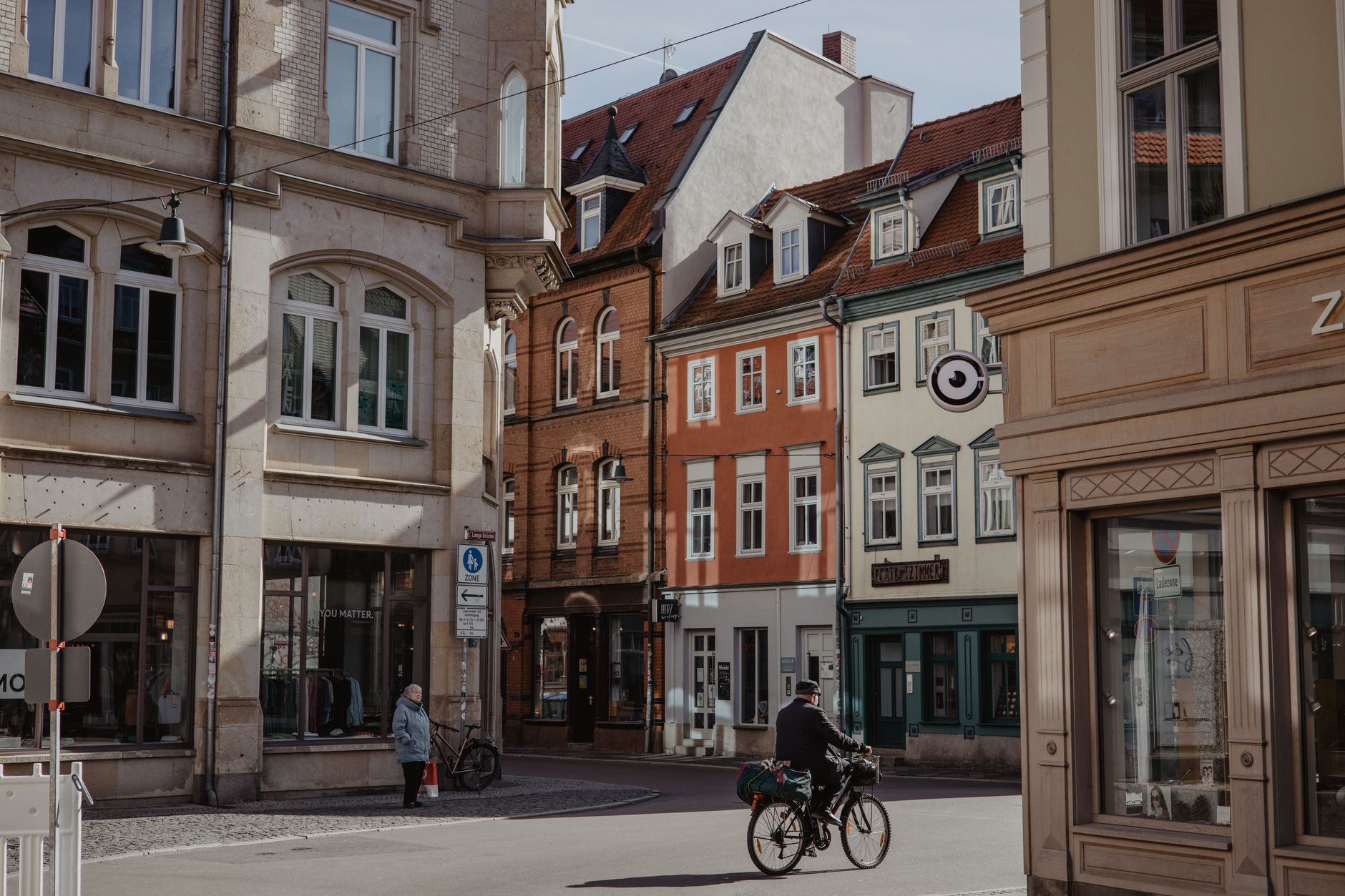
Erfurt is one of those cities where the parking question is settled not by your destination but by how long you are staying. Someone running an errand for an hour parks differently from someone staying all day — and the gap between those two strategies is wider in Erfurt than in comparable cities.
The reason lies in the structure of the old town. It is well preserved, densely built and largely not laid out for motor traffic. Parking therefore sits mostly at the edge of the historic core, and from there you walk.
The day ticket and what it costs
Let us start with the figure most people are looking for.
At the Domplatz car park, 24-hour parking costs €15.00 (as of 2026). That is the central reference point for the city centre: the building sits directly on the Domplatz, the city’s most important address.
For residents parking long-term, the same site charges €65.00 a month. That figure is instructive for visitors too, because it reveals how the place calculates: a month of permanent parking costs less than five day tickets.
From which follows a practical rule. If you are staying several days in Erfurt and need to leave a vehicle, ask about weekly or multi-day rates rather than adding up day tickets. The pricing structure of such car parks rewards longer stays substantially, and the relevant tariffs are rarely on the website.
By way of comparison, a car park outside the centre has recently been quoted at €5.00 for a day ticket. The ten-euro difference corresponds roughly to what you invest in a walk or a tram ride.
The charging zones
Erfurt operates graduated parking charge zones in the centre, and the city publishes a map showing them, including the Begegnungszone or shared-space zone. It is available as a PDF download on the city’s own pages.
I would strongly recommend looking at that map before you drive, for a specific reason: the zone boundaries follow the historic street plan rather than any logic you could work out on the ground. One street can sit in the expensive zone while the parallel street is already cheaper.
On the shared-space zone, a point that goes beyond parking: in such areas pedestrians, cyclists and motor vehicles share the surface and vehicle traffic has lower priority. Looking for a space there means looking in the wrong place — these zones are not intended for it.
That a zone scheme can be built quite differently is clear from another eastern German state capital: parking in Dresden manages the whole city with three zones — at the price of a boundary that, in two places, runs down the middle of the street.
When park and ride is the better sum
Erfurt operates park and ride sites connected to the municipal transport network. For a substantial share of visits that is the more sensible option, and I say that as somebody who does not condemn central car parks on principle.
The arithmetic is simple. A day ticket in the central car park is €15. An edge-of-town space plus tram fares for two people comes to noticeably less — and in Erfurt the tram sets you down in the old town itself, because the network is laid out for exactly that.
The time difference is smaller than it appears. You save yourself the hunt, the drive into narrow lanes, and the exit in the evening when everybody leaves at once.
Where park and ride does not fit: if you need to return to the vehicle several times a day, if you are carrying anything heavy, or if you are driving back late in the evening when frequencies thin out. In that case check the last service before committing.
How the same system looks in larger cities is described in park and ride in Hamburg; a considerably stricter example is covered in park and ride in Amsterdam.
Why almost everybody wants the Domplatz
It is worth explaining briefly why a single car park dominates this city.
The Domplatz is Erfurt’s central square, and above it stand the cathedral and the Severikirche as the ensemble in every picture of the city. From there you reach on foot, within minutes, the Krämerbrücke — the inhabited bridge that is among the few of its kind in Europe — and the Anger, the main shopping street and the hub of the tram network.
Those three destinations sit so close together that for a visit to the city you need one parking space and no more. Anyone moving the car between stops in Erfurt has mis-planned.
For your choice that means a space at the edge of the historic core is not a compromise but the normal solution. Distances inside the old town are short; what gets long are the distances by car around it.
Advent, market days and other exceptional states
A point that goes beyond the question of charges and can save you a wasted drive.
The Erfurt Christmas market on the Domplatz is among the better-known in Germany and draws substantial numbers through Advent. In that period the square itself is occupied, the central car parks fill early, and some approach roads are altered or closed.
The same applies in milder form on market days and during city festivals.
In those periods I would not attempt to park centrally at all. The sum that otherwise falls narrowly in the car park’s favour tips decisively: you sit in circling traffic while the tram goes past you.
Check the city’s notices about closures before such dates. That is the one minute that separates arriving from circling.
Plan the approach, not the arrival
A point regularly underestimated in compact old towns.
In Erfurt it is not the car park that determines your walking time but which side of the centre you approach from. Arrive from the north having committed to a car park in the south and you will circle the historic core — through streets not built for it.
So decide first where you are going, then which direction you are coming from, and only then choose the car park. That order sounds obvious and is rarely followed.
A second note for weekends and event periods: Erfurt is a state capital with a very full events calendar in its centre. On market days, through Advent and during festivals the central car parks fill early and some approach roads are closed. That is the moment when park and ride is not the cheaper option but the only one that works.
Car park or kerbside?
A trade-off that resolves more clearly in Erfurt than in many other cities.
At the kerb you pay at the machine and stand in one of the charging zones. The hourly rate is lower than in a car park, but the spaces are generally time-limited, and in the centre they are simply rarely free. For a short appointment that is the right choice; for a day it is not.
In a car park you pay more per hour but without a maximum stay and without the question of whether you will be back in time. The day ticket caps the sum — and that cap is the real thing you are buying.
The threshold, in my view, sits at about two to three hours. Below it the kerb wins if you find a space. Above it the car park is cheaper as soon as you count the time spent hunting.
One detail many overlook: the maximum stay is not a suggestion. If a sign permits two hours and you buy a two-hour ticket, you may not simply buy another and stay put afterwards. In many cities that is a common and expensive misunderstanding.
And if you are genuinely unsure whether you will stay one hour or four: take the car park. The premium on the first hour is smaller than the fine for the fourth.
What I would settle before driving
How long you are staying, honestly estimated. Under two hours the centre is worth it; from half a day the sum tips towards a day ticket or park and ride.
Whether your destination is in the pedestrian zone. Hotels in the old town do not necessarily have their own spaces, and access is partly restricted. Ask the hotel before you find yourself with luggage in front of a bollard.
How you will pay. Machines and barriers do not accept the same means everywhere. Keeping some cash in the car remains the most reliable precaution in mid-sized cities.
The current tariffs. Municipal parking charges are adjusted regularly, and individual car parks change their own structures independently.
Why private customer car parks bring a contractual penalty rather than a fine is set out in parking at the supermarket.
How a large city manages its kerbside parking zone by zone is shown under Berlin parking zones.
All figures reflect the position in 2026 and come from the operators or the city. Parking charges, zone boundaries and the list of park and ride sites all change; the signage on the ground and the city’s official overview take precedence. What does not change is the underlying structure: Erfurt’s old town is served on foot, and every parking decision is at heart a decision about which edge you start from. More city centres under City Parking.
Keep reading
City Parking
Parking in Dresden: €6 a Day at the Semperoper, €28 on the Altmarkt
Parking in Dresden in 2026: the city's three charging zones, the old-town car park ring from €6 to €30 a day, the Äußere Neustadt charged until midnight, and why the Elbe meadows are off limits.
Dr. Eva Sommer17 September 2026
City Parking
Free Parking in Hamburg: Sunday Is the Exception, Not the Rule
Free parking in Hamburg in 2026: why only twelve of 62 resident parking zones are free on Sundays, when charging actually stops in the evening, and where a disc is enough.
Dr. Eva Sommer17 September 2026
City Parking
Berlin Parking Zones: €20.40, but a 16-Week Wait
Managed parking in Berlin: €1 to €3 an hour, a resident permit at €20.40 for two years — and new zones in Friedrichshain-Kreuzberg during 2026.
Dr. Eva Sommer15 August 2026
City Parking
Frankfurt Christmas Market Parking: Römerberg, Paulsplatz and the Hauptwache
Parking for the 2026 Frankfurt Christmas Market (23 November to 22 December): which car parks serve the Römerberg, Paulsplatz and Hauptwache, what they charge, which streets close, and when park and ride at Borsigallee is worth it.
Dr. Eva Sommer25 September 2026
City Parking
Parking in Central Munich: Garages, Residents' Zones and the Low-Emission Zone
Parking in central Munich in 2026: what garages from Marienplatz to the main station charge, €2.50 an hour on the old-town kerb, 77 residents' parking zones, three free hours for electric cars and the diesel ban on the Mittlerer Ring.
Dr. Eva Sommer25 September 2026